Where Art Lives
Density, Income, and the Geography of Arts Infrastructure in America
Abstract
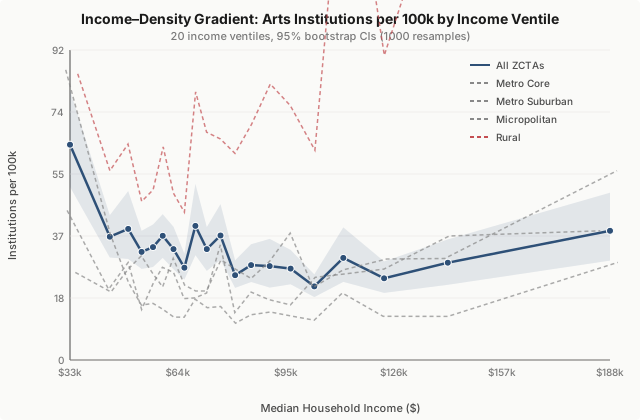
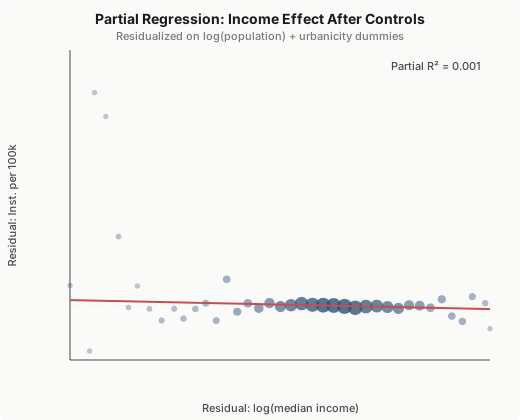
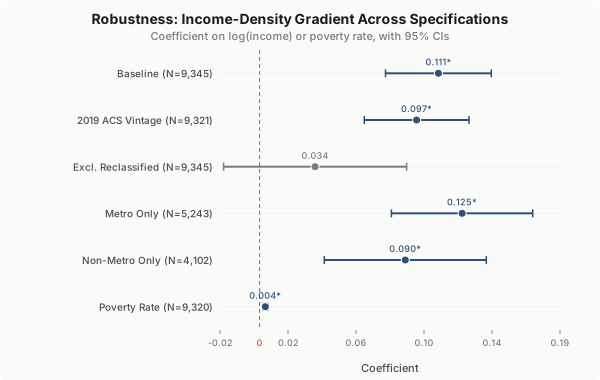
Where do America’s arts institutions concentrate, and what determines which communities have them? We link 60,643 arts organizations identified in IRS filings to Census American Community Survey data at the ZIP Code Tabulation Area (ZCTA) level and find that the conventional framing — wealthy areas attract the arts — obscures a more fundamental pattern. Population density, not household income, is the primary predictor of arts institution density, explaining 66% of variation in a log-linear model compared with income’s modest incremental contribution.
The urbanicity gradient is steep: metro core ZCTAs average 61 percentage points more arts institutions per capita than rural areas, while a one-standard-deviation increase in median household income predicts only an 11% increase in institution count after controlling for density. The relationship between income and arts infrastructure is heterogeneous across art forms: museums exhibit a negative income elasticity of −0.77 after controlling for urbanicity, while media arts organizations cluster in higher-income areas. When we turn from institutional presence to funding flows, income reasserts itself: the highest-income quintile receives 1.32 times its proportional share of grant dollars, and an Oaxaca-Blinder decomposition attributes 148% of the funding gap to unexplained location premiums. We identify 938 arts desert ZCTAs — not rural, but dense suburban communities where population growth has outpaced cultural infrastructure. A difference-in-differences analysis of the 2022 e-filing mandate confirms the visibility shock was geographically neutral.
These findings reframe the geography of cultural access: density creates the infrastructure, funding networks concentrate its benefits toward wealth, and the binding constraint on cultural participation is not income but proximity to the institutional apparatus of legitimation.
Key Findings
Population density, not household income, is the primary predictor of arts institution density. Urbanicity explains 66% of variation in a log-linear model. Metro core ZCTAs average 61 percentage points more arts institutions per capita than rural areas. A wealthy exurb at the 90th percentile of income has fewer arts institutions per capita than a moderate-income urban neighborhood. Income operates at the margin; density is the binding constraint.
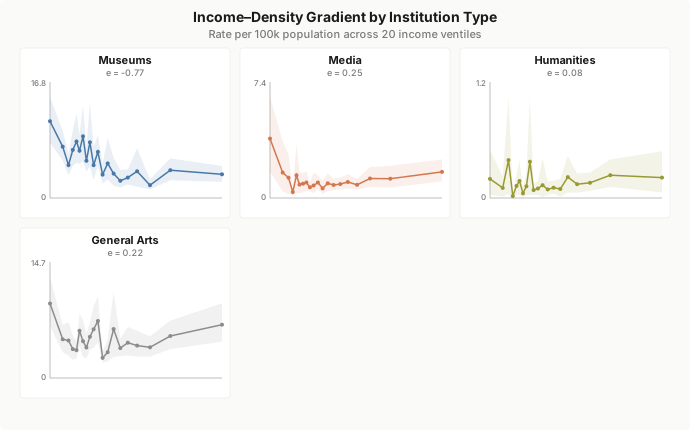
The aggregate density gradient masks striking heterogeneity across art forms. Museums exhibit a negative income elasticity of −0.77 after controlling for urbanicity — they concentrate in lower-income urban cores, anchored to historic cultural districts. Media arts organizations show a positive elasticity of +0.25, clustering where creative professionals live. The z-test comparing these coefficients is highly significant (z = 11.43, p < 0.001). Any unitary account of “arts access” obscures meaningful structural variation.
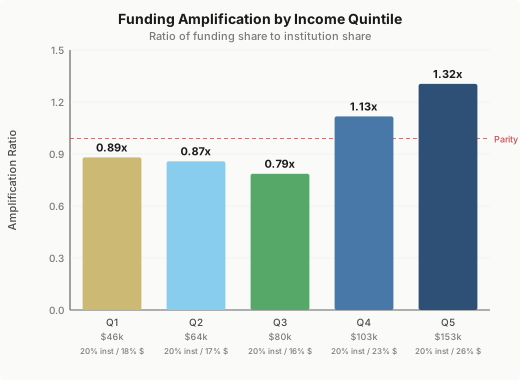
While density determines where arts institutions are, income determines how much money they receive. The highest-income quintile of arts-bearing ZCTAs receives 1.32 times its proportional share of grant dollars. An Oaxaca-Blinder decomposition attributes 148% of the Q5–Q1 funding gap to unexplained location premiums — the network amplifies geographic advantage beyond what institutional composition can explain. Middle-income ZCTAs (Q3) are the most underfunded at 0.79x, falling through both targeted philanthropy and proximity-based giving.
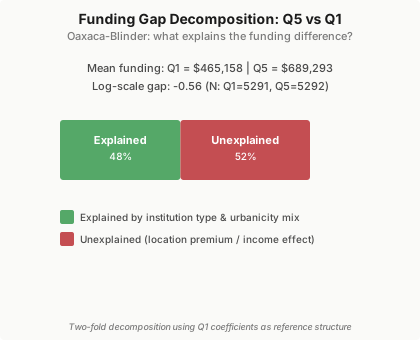
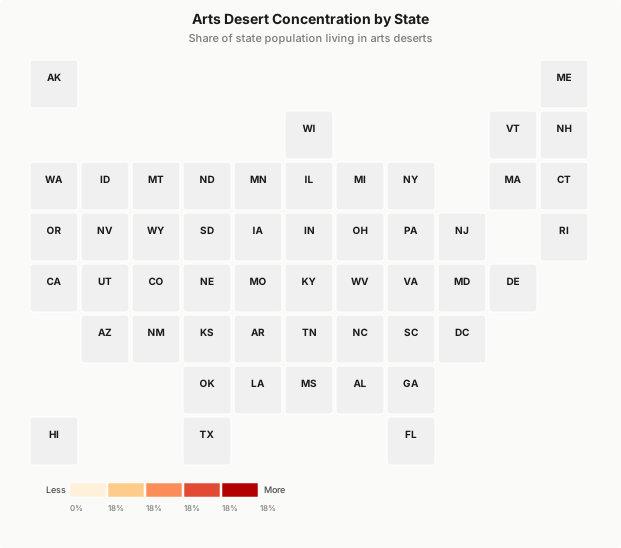
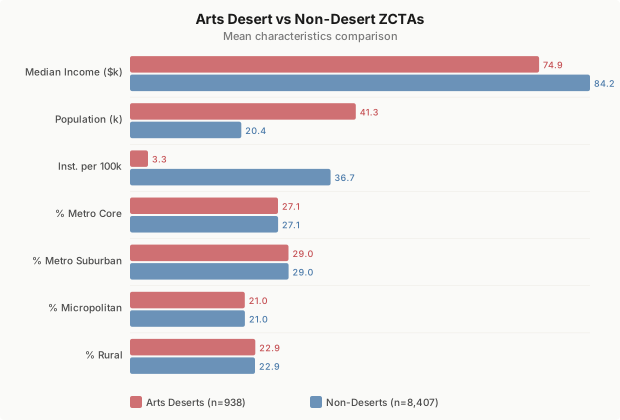
We identify 938 arts desert ZCTAs where observed institution counts fall significantly below population-predicted levels. These deserts are not rural — they are dense suburban communities: Houston exurbs, Southern California inland cities, Bay Area suburbs. ZCTA 77449 (Katy, Texas) has 122,000 people and one arts organization; it should have nearly six. The 938 desert ZCTAs are home to 24 million people, a population equivalent to the ten largest American cities combined.
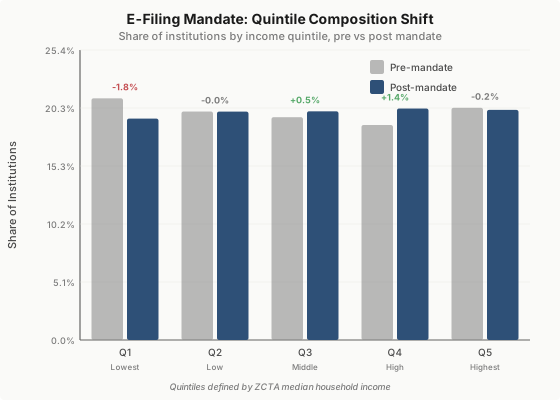
The 2022 federal e-filing mandate doubled the number of visible grant-making foundations. A Kolmogorov-Smirnov test shows the income distributions of entrant and incumbent recipient ZCTAs are nearly identical (D = 0.024). The difference-in-differences specification shows only marginal shifts: the largest is a 1.8pp decline in Q1’s funding share. The geographic distribution of arts funding is not an artifact of selective observation; it is a structural feature of the system.
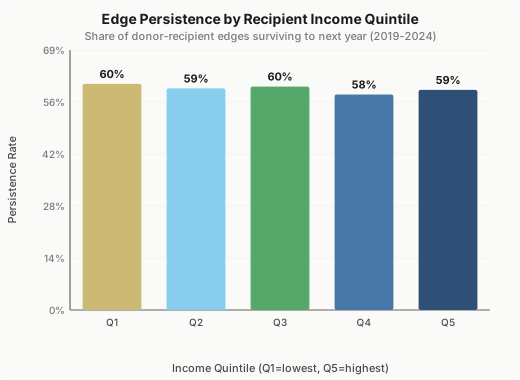
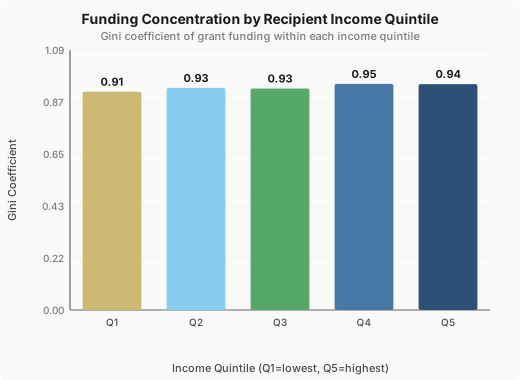
Preferential attachment is sharply concentrated by geography: the correlation between current in-degree and new edge acquisition is 0.87 in the wealthiest communities (Q5) but only 0.36 in Q3. The “rich get richer” dynamic is nearly 2.5 times stronger in high-income areas. Edge persistence, by contrast, is stable across quintiles (57.6%–60.4%). The network amplifies geographic inequality not through differential persistence but through differential attachment.
Figures
The Density Gradient
Art Form Stratification
Funding Amplification
Arts Deserts
E-Filing Mandate

Network–Geography Interaction
Robustness
Interactive Companion
Explore the geographic distribution of arts institutions interactively. The map links every arts organization in our dataset to its ZCTA, income quintile, and art form category — allowing you to see the density gradient, funding amplification, and arts deserts at the community level.
Methodology Note
This analysis links three data sources. Arts institution data comes from the IRS Business Master File (NTEE major group A) supplemented by the grant network entity resolution pipeline from The Legitimation Economy, yielding 60,643 unique arts organizations. Census ACS 2022 5-Year Estimates provide median household income, population, population density, educational attainment, race/ethnicity, and median age at the ZCTA level for 33,120 ZCTAs. Grant flow data comes from 384,543 IRS Form 990-PF filings across 2019–2024.
Six analytical approaches are employed: (1) OLS and Poisson regression of institution density on income and urbanicity; (2) art form-specific Poisson regressions for income elasticity heterogeneity; (3) Oaxaca-Blinder decomposition of funding gaps by income quintile; (4) Poisson-based arts desert identification (observed < 0.5 × predicted, p < 0.05); (5) Kolmogorov-Smirnov and difference-in-differences tests of the 2022 e-filing mandate; (6) network parameter estimation (edge persistence, preferential attachment, Gini) by ZCTA income quintile.
Key limitations include the ZIP-to-ZCTA crosswalk imprecision (5–8% of rural organizations potentially misassigned), a 44% join rate between arts organizations and Census data, and 12% classification noise in keyword-matched art form assignments. Full methodological details are in the paper draft.
This paper and its companion describe the same system from two vantage points. The Legitimation Economy documented who gets funded — the network of grants with its preferential attachment, edge persistence, and geographic modularity. This paper asks where they are. The two converge on a single conclusion: the selection apparatus that governs American arts philanthropy is spatially concentrated, institutionally persistent, and self-reinforcing. The legitimation economy has a zip code.