Do Rationalists Dream of Electric Art?
How communities shaping AI governance talk — and don’t talk — about art
Abstract
This paper argues that as the marginal cost of cognitive production falls, scarcity relocates from production to legitimation. Art makes that shift visible because its value depends less on output scarcity than on institutions of judgment, public interpretation, and social ratification. The question is therefore not simply whether alignment-adjacent communities discuss art, but what kind of value model becomes legible when art enters view.
In a hand-verified corpus of 6,279 posts from September 2022 through March 2026, art appears in only 34 posts (0.54%), with the sharpest scarcity in the technical core. When art does appear, literature and terminal framing dominate, while outright dismissal is rare. A 50,378-post retrieval substrate and a historical arts-critical comparison corpus for 2023-2025 (15,448 documents; 34,509 art-only passages) then extend the project from a scarcity note to a comparative discourse-legitimation paper. Current comparative results support one scalable claim and one bounded one. AI relation is the strongest surviving axis: alignment-adjacent passages more often treat AI as constitutive medium or practice, while arts-critical passages more often frame AI as tool, opportunity, labor dispute, or governance problem. Differences in object of valuation also appear substantive, but remain review-gated and are used directionally rather than as flat headline percentages. The broader claim is that alignment-adjacent and arts-critical discourse are two historically distinct evaluative institutions operating under conditions of cheapening intelligence.
Introduction
Generative AI has made one historical shift unusually easy to see. As AI lowers the marginal cost of cognitive production, scarcity relocates — a mechanism explored in the next section. The central cultural question of AI is therefore not only what can be generated, but what remains legible as valuable once generation becomes cheaper.
Art is the right stress test for that shift because its value is least reducible to productivity or coordination efficiency. Artistic labor does not disappear when models get better, but the social conditions under which art is recognized, filtered, funded, and remembered change sharply. A regime that can talk fluently about AI safety, model capabilities, and governance while only weakly rendering art legible is not merely neglecting one topic among many. It is revealing something about what it thinks culture is for.
Why these forums specifically? The Alignment Forum, LessWrong, and the EA Forum are small by traffic standards, but their influence on AI governance is disproportionate. Major AI safety researchers publish there. AI lab hiring pipelines draw heavily from these communities. Policy frameworks on existential risk, AI alignment, and responsible scaling have roots in discourse that originated on these platforms.9 If these communities' evaluative frameworks shape how AI governance handles cultural questions, then the structure of their discourse about art is not a niche curiosity — it is a policy-relevant signal.
In The Legitimation Economy, we measured the institutional side of this problem: how scarce endorsement, relationship capital, and network position shape the allocation of arts funding. DRDEA asks the discourse-side analogue. How do communities most actively shaping AI strategy, governance, and long-run futures make art legible as valuable? The initial answer was a scarcity finding. The stronger answer is sociohistorical: alignment-adjacent discourse and arts-critical discourse encode two historically distinct institutions of judgment under cheapening intelligence.
This paper does not require a precise fast-takeoff forecast. It requires only a historically observable mechanism: post-2022 generative AI already makes cheapened cognitive production culturally salient, which in turn increases the importance of filtering, legitimacy, rights, institutional translation, and public judgment.
Cheap Intelligence and the Return of Legitimation
The strongest version of the argument is not that production scarcity vanishes. It is that production scarcity becomes a weaker explanation for value in some domains, while selection scarcity becomes a stronger one. When text, image, and music generation get cheaper, value shifts toward infrastructure, ownership, distribution, filtering, and the institutions that convert raw abundance into durable public judgment.
Art makes this mechanism unusually visible because art has never depended only on the cost of making another object. It has always depended on thicker social processes: criticism, curation, museums, magazines, collectors, publics, pedagogy, and the ability to distinguish what is merely produced from what is worth keeping. In that sense, art is not a sentimental exception to AI economics. It is the clearest domain in which legitimation remains scarce even when output becomes abundant. Calling art a stress test does not reduce it to an external proxy; it recognizes that arts institutions have long managed the gap between abundant production and scarce public ratification.
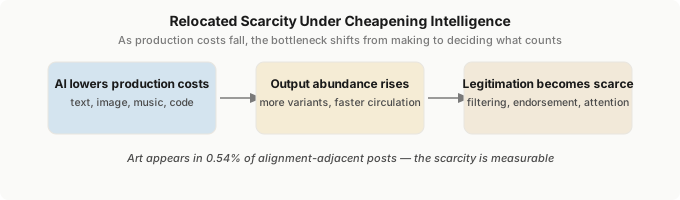
Its claim is not that art enjoys mystical exemption from economics, or that artistic labor disappears. The claim is narrower: art is the domain where relocated scarcity is easiest to diagnose because it concentrates questions of taste, labor, memory, publics, and legitimacy.
Research Object
The object of study is no longer just art frequency in alignment discourse. It is discourse legitimation8: the set of frames, authorities, and evaluative assumptions through which art becomes intelligible inside alignment-adjacent communities. In practical terms, the paper asks four linked questions.
- How rarely does art appear in alignment-adjacent discourse, and where is that rarity most acute?
- When art appears, which art forms and value frames become legible?
- How much larger is the retrievable substrate once the corpus is expanded beyond the initial hand-audited window?
- How should a comparative analysis be structured if the goal is to compare alignment-adjacent discourse to arts-critical public discourse without collapsing into generic sentiment analysis?
The comparative object is therefore not “do these corpora feel different?” It is whether alignment-adjacent and arts-critical discourse apply different evaluative regimes4: different answers to what art is for, where judgment sits, and how AI enters the scene. That is the bridge to TLE. TLE studies legitimation in allocation. DRDEA studies legitimation in discourse.
Two Discourse Regimes
The corpora in this paper are not just two piles of text. They are historically formed institutions of judgment.7 Alignment-adjacent discourse is a digitally native, technocratic field shaped by engineering, analytic philosophy, economics, forecasting, and internet rationalism. Its dominant problems are risk, optimization, coordination, governance, and intervention design. Arts-critical discourse is institutionally layered and historically thick. Its dominant problems are form, labor, publics, institutions, memory, and contested judgment. Treating these as two historically distinct institutions of judgment does more explanatory work than treating them as style clusters.

That difference is not merely stylistic. It reflects divergent institutional histories and different positions inside the current AI transition. Alignment-adjacent venues are optimized to reason about systems. Arts-critical venues are optimized to reason about cultural objects, artistic labor, institutions, and publics. The comparison is therefore sociological before it is lexical.
The arts regime in this corpus is also more institutionally rooted than a generic “arts blogs” label would suggest. It includes museum writing about permanent collections and exhibition architecture, criticism about biennial selection and canon formation, trade reporting on galleries and auctions, and news coverage of war, protest, repatriation, and heritage law. These outlet families inherit postwar museum expansion, magazine criticism, donor-board governance, biennial circuits, and current fights over restitution, copyright, and cultural policy. In the current build, arts discourse is routinely about how artworks are acquired, housed, defended, translated, and historicized. That is why it makes sense as a comparison set for legitimation rather than as a simple control group of people who like art more.
Evidence Tiers
The revised paper uses three evidence tiers. Each tier supports different claims. The numbers should not be pooled as if they describe the same empirical object.
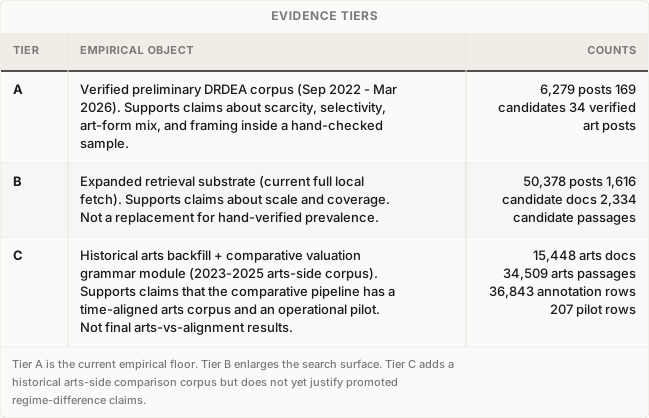
This draft does not yet claim publication-grade regime differences between alignment-adjacent discourse and the arts-critical public sphere as a whole. The arts corpus is historically backfilled for 2023-2025 across six outlets and the planned five families, and the comparative module now includes a fully resolved solo pilot. But the strongest current comparison is still proxy-based rather than independently human double-coded, so promoted regime differences remain bounded.
Method
Corpus A: Alignment-Adjacent Discourse
The verified preliminary result is based on 6,279 posts from five alignment-adjacent venues: the Alignment Forum, LessWrong, the Effective Altruism Forum, 80,000 Hours, and Astral Codex Ten. The current hand-audited window runs from September 2022 through March 2026. For descriptive purposes, the corpus is split into three discourse regimes by proximity to technical alignment research: core alignment (1,981 posts), rationalist public sphere (1,813 posts), and EA / institutional discourse (2,485 posts).
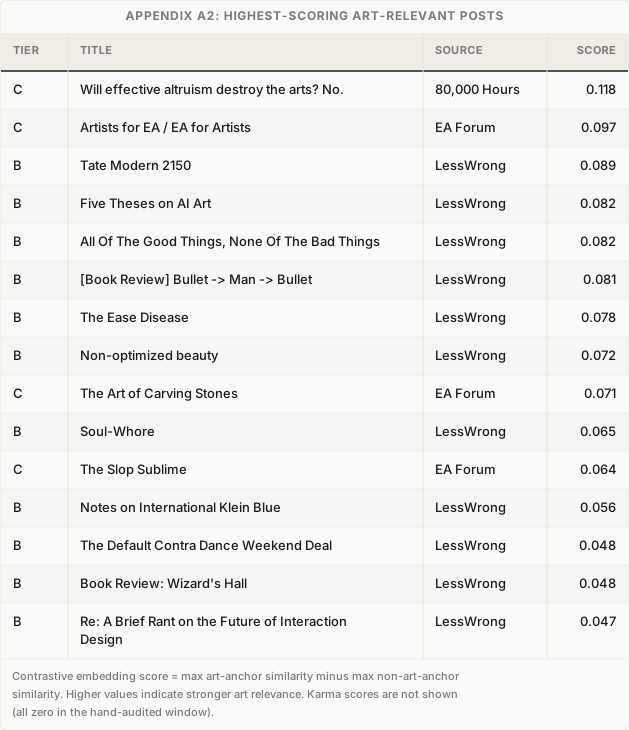
Retrieval used contrastive embedding similarity rather than keywords. Each post was embedded with BGE-small-en-v1.5 and compared against art anchors and non-art anchors; a post was flagged when its maximum art-anchor similarity exceeded its maximum non-art-anchor similarity by at least 0.02.1 This design is necessary because art appears in these corpora indirectly, analogically, and often without stable lexical markers. Semantic retrieval is therefore more appropriate than keyword search,5 even though the initial threshold was intentionally recall-heavy and precision-light.2
The art anchors used for contrastive retrieval were drawn from six semantic domains: visual art practice (painting, sculpture, installation, gallery exhibition), performing arts (theater, dance, opera, live performance), literary production (poetry, fiction, literary criticism, publishing), music (composition, concert, recording, musical tradition), arts institutions (museum, arts council, cultural foundation, arts funding), and arts criticism (aesthetic judgment, curatorial practice, art market, cultural heritage). Non-art anchors covered: AI safety and alignment (mesa-optimization, reward hacking, scalable oversight), rationalist epistemics (Bayesian reasoning, calibration, prediction markets), effective altruism (cause prioritization, expected value, counterfactual impact), and general technology (software engineering, startup, product development). Each domain contributed 3–5 anchor phrases, totaling 24 art anchors and 16 non-art anchors.
All 169 candidates in the preliminary run were hand-reviewed. That audit produced the 34-post verified art corpus used for the current frequency, framing, and art-form results. It also exposed the main failure mode of the initial classifier: philanthropy and donation posts in the EA / institutional regime often looked close to “arts funding” anchors without actually being about art. The gap between the initial candidate rate (2.69%) and the verified rate (0.54%) is therefore methodologically important in its own right. Tier A remains the only promoted prevalence claim.
Tier B: Expanded Retrieval Substrate
Since the initial verified run, the corpus has been expanded to 50,378 posts. The full embedding pass yields 1,616 candidate documents and 2,334 candidate-filtered passages. This larger substrate changes the paper architecturally rather than epidemiologically. It shows that DRDEA is no longer a small-window retrieval exercise and can sustain passage-level comparison, but it does not replace the verified prevalence estimate because the full pass has not been promoted through a second manual audit.
Corpus B: Arts-Critical Public Discourse
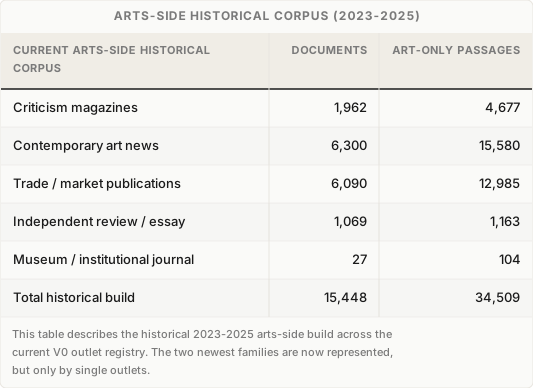
The comparative module uses a separate arts-side corpus built by outlet family rather than by traffic rank. The current historical build includes six outlets across five families: Hyperallergic (contemporary art news), Artforum and Art in America (criticism magazines), ARTnews (trade / market publication), Guggenheim (museum / institutional journal), and BOMB Magazine (independent review / essay). As of March 20, 2026, this backfilled 2023-01-01 through 2025-12-31 build contains 15,448 normalized arts documents and 34,509 art-only passages. The one-year offset from Corpus A (which begins September 2022) means the earliest alignment-adjacent posts — including the immediate post-ChatGPT period — have no arts-critical counterpart. This is a coverage gap, not a design choice, and future builds should extend the arts corpus backward.
This is no longer merely an available corpus. It is a time-aligned historical comparison set for the planned V0 regime map. But some families remain thin: the museum / institutional and independent review / essay families are each represented by a single outlet, so the arts side should still be treated as a strong but incomplete slice of arts-critical public discourse rather than the whole field.
Comparative Module: DRDEA_CVG_V0
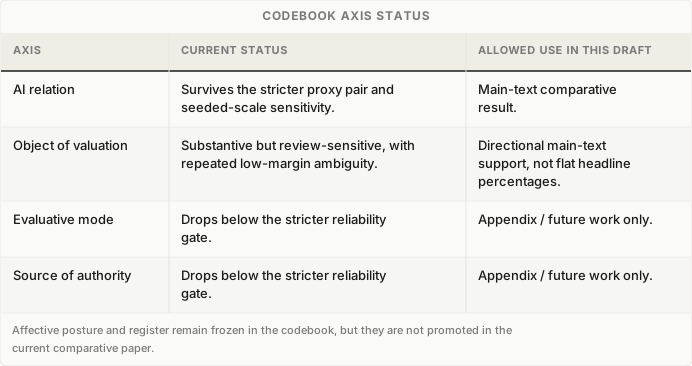
The comparative layer, DRDEA_CVG_V0, shifts the unit of analysis from document to passage because full essays mix summary, reportage, quotation, and evaluation. Passage-level windows are the right unit for identifying valuation grammar — the evaluative assumptions and frames through which value is assigned —. The frozen codebook defines six axes, but this draft promotes only those that survive the current reliability gates. In practice that means one robust main-text axis (ai_relation) and one review-gated supporting axis (object_of_valuation). The full proxy-pair, seeded-scale, and low-margin review workflow remains in the appendix because it matters for interpretation, not for the core narrative.
Verified Preliminary Findings
Scarcity Is Real, But It Is Not the Whole Story
The verified preliminary rate is low: 34 art-relevant posts out of 6,279, or 0.54%. That result survives the precision audit and remains the paper’s empirical floor. But the more revealing pattern is the distribution of that scarcity. Art is almost absent from the technical core and far more visible in the broader rationalist layer.
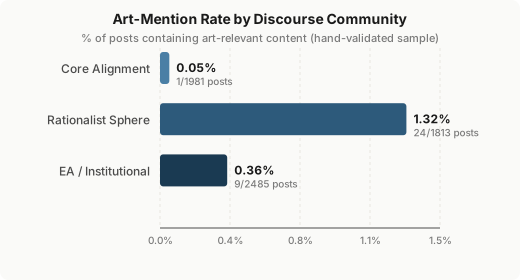
The key descriptive fact is therefore not just “low frequency.” It is a 26× gap between core alignment and the rationalist public sphere (though the core-alignment numerator is a single post, making this ratio sensitive to small-count variation). The places where AI is most explicitly theorized as a technical governance problem almost never discuss art at all. The places where adjacent communities reflect on human life more broadly are where art becomes intermittently legible.
Just as important, scarcity is not equivalent to contempt. The hand-audited corpus does not show a community repeatedly denigrating art. It shows a community that mostly routes attention elsewhere, then engages art through a small number of recurrent frames when it does appear.
What Art Becomes Legible
The verified corpus is not neutral across art forms. Literature and fiction dominate, followed by general art discourse and visual art. Digital / generative art is present but still marginal relative to how central it has become to public AI debate.
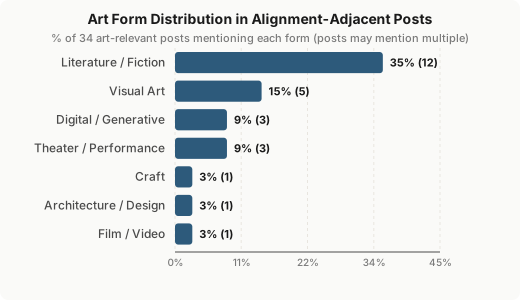
That distribution is substantively revealing. A writing-native discourse environment finds literature easiest to discuss. It is far less comfortable with forms that require institutional mediation, embodied spectatorship, or material encounter. The result is not a broad cultural field but a selective legibility surface in which forms already native to textual online communities are easier to value and easier to analyze.
The modest share for digital / generative art is especially important. The domain most obviously transformed by new AI systems is not absent, but it is not yet the dominant site through which these communities think about art either. Even in a corpus adjacent to AI discourse, generative art remains one small cluster inside a broader pattern of selective attention.
When Art Appears, It Is Usually Not Dismissed
The strongest conceptual result from the verified corpus is the framing distribution. The question becomes: what mode of value attribution is actually present when art enters alignment-adjacent discourse?
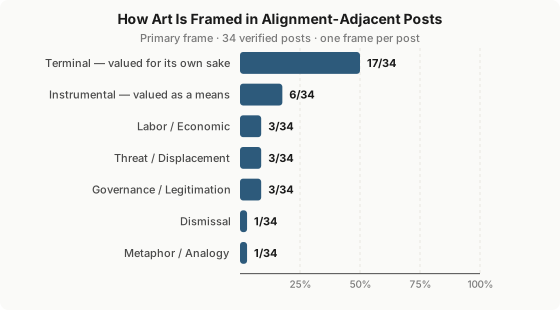
Terminal framing accounts for 17 of 34 posts, or 50% of the verified corpus. Instrumental framing accounts for 6 posts (18%). Labor / economic, threat / displacement, and governance / legitimation each account for 3 posts (9%), while outright dismissal and metaphorical use appear only once each. The stereotype that rationalist or EA-adjacent discourse simply treats art as frivolous is therefore not supported by the current hand-audited sample.
The sharper point is that the community does not need to reject art in order to reveal a limited discourse of value. Scarcity plus selective framing is enough. Terminal art engagement exists, but it is peripheral. Governance / legitimation appears at all, which is important for the bridge to TLE, but only as a thin slice. The paper’s claim is therefore not that alignment-adjacent communities hate art. It is that art is weakly and selectively legible inside the value model those communities publicly articulate.
Comparative Findings
The major upgrade in this draft is the comparative valuation grammar module, DRDEA_CVG_V0. Its purpose is not to ask whether alignment-adjacent and arts-critical writing have different emotional tone. Its purpose is to compare the grammar of valuation itself: what is valued, why, by whom, and in relation to AI. The body of the paper promotes only the comparative claims that survive the current reliability gates. Detailed proxy-pair, scaling, and low-margin review diagnostics appear in the appendix note below.
The comparative module now supports a narrower claim set than the original ontology envisioned. The historical arts corpus, passage shell, and balanced pilot are enough to show that cross-regime comparison is real and no longer merely aspirational. But at present only two axes survive strongly enough to matter in the body: AI relation and, more cautiously, object of valuation. Those axes are useful because they bear directly on the sociohistorical mechanism above. They show where each regime locates value and what each regime treats AI as doing inside culture.
AI Relation Is the Strongest Comparative Axis
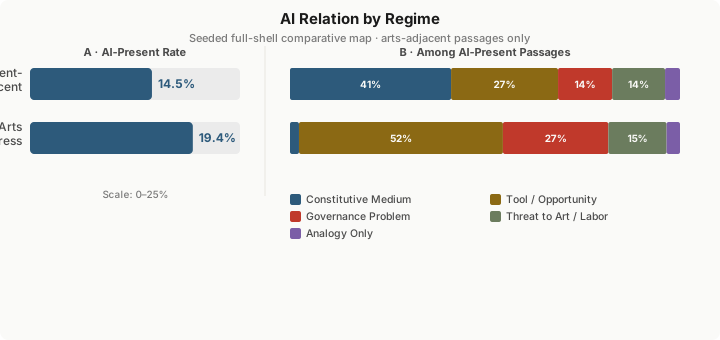
The clearest surviving comparative difference concerns how AI enters the scene. In both regimes, most passages are still AI-absent. But when AI is present, alignment-adjacent writing is more likely to treat AI as constitutive medium or practice, while arts-critical writing more often frames AI as tool, opportunity, or governance problem. In the seeded full-shell map, alignment-adjacent passages over-index on constitutive-medium usage (6.0% vs 0.4%), while arts-critical passages over-index on tool / opportunity framing (10.1% vs 4.0%) and governance-problem framing (5.2% vs 2.0%). That pattern survives threshold sensitivity, which is why AI relation is the only comparative axis promoted here as broadly scalable.
Object of Valuation Differs, But Only Directionally
The second surviving comparative axis concerns what the discourse takes to be the thing under evaluation. Here the paper can make a substantive directional claim, but not a flat numerical one. Alignment-adjacent passages repeatedly compress ambiguous cases toward an artwork / technology boundary. Arts-critical passages distribute ambiguity more broadly across artwork, institution, and artist. That is enough to say that the two regimes do not simply talk about art at different rates; they also center different objects when value is assigned.
What the current draft does not do is promote object-of-valuation percentages as stable headline results. Repeated low-margin review shows that this axis remains review-sensitive, especially in alignment-adjacent passages where the main ambiguity zone is still artwork ↔ technology / tool. On the arts-critical side, the recurring ambiguity zones remain artwork ↔ institution and artist ↔ artwork. In the body of the paper, object of valuation therefore supports interpretation rather than precise regime totals.
Promoted in the body: AI relation as a robust comparative axis, and object of valuation as a directional but review-gated one. Held out of the body: evaluative mode, source of authority, and any language implying publication-grade independent annotation reliability. Table 4 in the appendix note summarizes the current promotion status of all six axes.
Paired Readings: What Each Regime Notices
Quantitative differences become clearer when read back into concrete passages. The point of the paired readings below is not to elevate a few texts into definitive proof. It is to show how the comparative axes sound in practice when each regime confronts the same historical pressure: AI makes new forms of cultural production abundant, but leaves judgment unsettled.
Alignment-adjacent
In Turning off lights with model editing on the Alignment Forum, DALL-E functions primarily as an interpretable system. The interesting question is whether model editing can force a bedroom scene to contain unlit lamps, and what that reveals about internal representations, intervention design, and transfer beyond the prompt that triggered the behavior. Image generation becomes a diagnostic toy problem for interpretability.
Arts-critical
In Hyperallergic’s My Comics Collaboration With DALL-E, the same technology enters a medium already saturated with arguments about line, authorship, craft, and labor. The piece explicitly situates DALL-E against the single-author comics tradition, the “auteur” model, and Lynda Barry’s defense of the hand-drawn line as a living trace of individual expression.
The divergence is not about optimism versus pessimism. It is about the object under judgment. In one regime, image generation is a tractable systems problem. In the other, it is a disruption inside an existing medium, labor history, and authorship norm.
Alignment-adjacent
In the EA Forum essay The Slop Sublime, AI-generated culture becomes a novel aesthetic category. The author is interested in a new perceptual condition: a culture feed in which the very possibility of AI generation saturates reception and produces a strange mixture of grandeur, revulsion, and deception. The key move is aesthetic reclassification: AI imagery is not defective human art but a distinct sublime.
Arts-critical
In Hyperallergic’s AI Art Platform Hit With Copyright Lawsuit and related ARTnews coverage of artist lawsuits and policy concerns, the same technological wave is legible first as a rights, compensation, and institutional accountability problem. Getty, LAION-5B, copyright metadata, artist plaintiffs, and claims about career viability anchor the discourse before aesthetic philosophy does.
This is the strongest comparative result rendered qualitatively. Alignment-adjacent passages more readily absorb AI into the ontology of medium or practice. Arts-critical passages more readily route it through labor, law, and governance.
Alignment-adjacent
LessWrong’s Pierre Menard, pixel art, and entropy asks whether identical outputs can still count as distinct artworks once context, entropy, and authorial intention are taken seriously. The valued object is still the artwork, but it is handled at a high level of abstraction: an information-bearing cultural object whose status can be reasoned through Borges, channel capacity, and even examples like Blue Monochrome or Comedian.
Arts-critical
In ARTnews’s Galleries in Tehran Shutter Following Israeli Missile Strikes, the valued object is not only an artwork but an institutional and civilizational infrastructure: museums, collections, heritage law, UNESCO protections, and the public conditions under which art can survive war. The object of concern is distributed across institution, site, archive, and scene.
This is why object_of_valuation matters even as a bounded axis. The comparison is not merely between two vocabularies. It is between a regime that often centers artworks and tools in abstraction, and another that more readily centers artists, institutions, and the public infrastructures that make art durable.
Alignment-adjacent
In Making DALL-E Count, visual composition is treated as a model behavior: DALL-E slips into “grid mode” and arrangement heuristics once prompts require more objects. Composition is interesting because it reveals the model’s internal shortcuts and constraints.
Arts-critical
In Guggenheim essays such as Frank Lloyd Wright, Gego, and the Art of Creating Space and How the Guggenheim Collects Art, composition is not a side effect of a model but an institutional experience shaped by architecture, ramps, light, curatorial encounter, acquisition procedure, and permanent stewardship.
This pair makes the historical thickness of the arts regime especially clear. Both sides talk about arrangement and visual form, but one treats composition as an inferential clue about systems, while the other treats it as a public experience produced through architecture, curation, and collection.
All posts cited in paired readings are publicly accessible. Alignment Forum and LessWrong posts can be found by title search at alignmentforum.org and lesswrong.com respectively. Arts-critical sources are linked from their outlet homepages.
Discussion
The paper’s strongest conclusion is now sociohistorical rather than merely descriptive. The problem is not simply that alignment-adjacent communities discuss art infrequently.
That matters because AI governance discourse does not merely optimize policy variables. It also carries assumptions about which domains deserve preservation, public reasoning, and institutional care. A regime that rarely encounters art, and that most easily recognizes the forms already native to text-heavy online communities, may remain internally coherent while still narrowing the cultural objects it can treat as publicly consequential.
A necessary acknowledgment: this analysis is itself a product of the discourse it studies. The authors are alignment-adjacent researchers asking whether their own intellectual community attends to art. That reflexivity does not invalidate the findings — the corpus counts and framing distributions are empirical — but it does mean the interpretive frame is not neutral.
The comparative valuation grammar module sharpens that concern in a narrower but more defensible way than the original ontology promised. The cleanest current comparative difference is how AI enters the frame. The second is what the discourse takes to be the thing being valued. Those are not trivial additions to a scarcity paper. They move DRDEA from “art is rare here” to a stronger claim: alignment-adjacent and arts-critical discourse are two historically distinct evaluative institutions operating under relocated scarcity.6
Counterarguments
Four objections deserve to be answered directly.
First: perhaps these differences are trivial because the audiences are different. That objection is partly right and does not damage the paper. The claim is not that one regime has failed to approximate the other. The claim is that these are historically distinct institutions of judgment, and that their differences matter because both now participate in shaping how AI and culture are publicly understood.
Second: perhaps scarcity alone only reflects topic mix, not a theory of value. That would be a valid criticism of the paper’s first version. It is why the current draft does not stop at corpus frequency and why the comparative module works at the level of art-relevant passages rather than whole corpora. The surviving comparative axes and paired readings matter precisely because they show that when art does appear, it is not simply slotted into the same evaluative machinery on both sides.
Third: perhaps the arts corpus is too partial to bear a regime-level argument. This is the strongest empirical objection, and the paper accepts its force. The arts side is a bounded five-family slice, not the whole arts-critical public sphere. That is why the paper promotes only ai_relation as a scalable comparative axis, keeps object_of_valuation directional, and leaves the deeper ontology in the appendix.
Fourth: perhaps the paired readings are cherry-picked. Of course they are curated; that is what close reading is. But they are not being used as prevalence estimates or as substitutes for the bounded comparative map. Their job is narrower: to make the surviving axes audible in prose. If ai_relation and the directional object-of-valuation contrast disappeared, these pairs would lose evidentiary force as well.
Fifth, a skeptic may ask: why should alignment-adjacent communities discuss art at all? Specialization is normal; not every community covers every topic. The concern is not that these communities should allocate more posts to art. It is that the evaluative machinery they have built — optimized for reasoning about risk, coordination, and long-run futures — does not readily accommodate the kinds of public goods, institutional care, and non-instrumental value that art concentrates. When those communities write governance frameworks that affect cultural production at scale, the thinness of their cultural legibility becomes a governance gap, not merely a topic gap.
The important negative result is equally useful. The paper does not yet know enough to promote stable claims about evaluative mode or source of authority. Those remain the deeper theoretical prize, but they should stay in the appendix and methods frame until reliability improves. It means the paper is organized around admissible claims rather than around the largest ontology it could imagine.
The broader implication is not that artistic or intellectual labor disappears. It is that as the marginal price of many outputs falls, value shifts toward ownership, filtering, infrastructure, rights, and public judgment. Art is diagnostic because it concentrates those pressures in an unusually visible form. What each regime can recognize as worth preserving becomes an indicator of the kind of human future it is prepared to optimize for.
The companion paper, The Legitimation Economy, documents the allocation-side complement: a network where past endorsement predicts future endorsement, where relationships are stickier than chance, and where gateway donors determine which organizations survive. DRDEA adds the discourse layer. Together, they suggest that legitimation operates on at least two surfaces — money and attention — and that the two surfaces do not necessarily select for the same objects.
Limitations
Four limitations should remain explicit.
- Small verified corpus. The current publication-honest result still rests on 34 hand-verified art posts. Frequency, art-form, and framing percentages are therefore descriptive and directional rather than statistically settled.
- Expanded retrieval is not audited prevalence. The 50,378-post substrate and 1,616 candidate documents materially improve scale, but they have not yet been promoted through a second manual prevalence audit. Tier B is a retrieval surface, not a new verified headline rate.
- The arts corpus is historical but still thin in two families. The current arts-side build is backfilled for
2023-2025across the planned five families, but museum / institutional and independent review are each represented by a single outlet. - The comparative module is not independently double-coded. The strongest current comparative artifact is a solo-adjudicated proxy pilot plus a seeded model-based full-shell map on two axes. That is enough for bounded working-paper notes and internal scaling, but not for publication-grade regime-difference claims.
Inside the current solo workflow, the practical next step is no longer to widen the ontology. It is to consolidate the paper around the axes that survived, keep object-of-valuation claims review-gated, and treat independent double-coding as the main future strengthening step if stronger public comparative claims are needed. Outlet depth within the museum / institutional and independent-review families also still needs to improve before any pooled cross-regime claim should be treated as field-level. The sociohistorical argument should therefore be read as a disciplined mechanism claim, not as a license to overstate the settledness of the comparative coding.
Appendix Note: Comparative Reliability and Scaling
The comparative module is real, historical, and operational. But not every axis is equally usable, and the main text has been cut back accordingly.
The historical pilot contains 207 balanced passages. An initial heuristic dual pass retained evaluative mode, object of valuation, source of authority, and AI relation above the working threshold. A stricter reviewed-vs-skeptical proxy pair narrowed the stable set to object of valuation (κ=0.658) and AI relation (κ=1.000). The perfect agreement on AI relation reflects the axis's operational simplicity: in the 207-passage pilot, 178 passages (86%) were coded AI-absent by both passes, leaving only 29 AI-present passages. Among those 29, the six-category AI-relation label was unambiguous in every case — the remaining disagreements were one-sided blanks (one pass left the field empty) rather than contradictory non-empty labels. Perfect kappa is therefore an artifact of high class imbalance and low ambiguity on the non-dominant classes, not evidence of trivially easy annotation. Because the remaining disagreements were one-sided blanks rather than contradictory non-empty labels, a solo-resolved version of the pilot could be constructed for internal comparative work.
Using that solo-resolved pilot as a seed set, I scaled object of valuation and AI relation across the full 36,843-row historical shell. The scaling classifier was a logistic regression over BGE-small-en-v1.5 passage embeddings, trained on the 207-passage seed set. Leave-one-out cross-validation on the seed set yielded the accuracy and macro-F1 figures reported above. Leave-one-out validation on the seed set is strong for object of valuation (accuracy 0.915; macro-F1 0.889) and strong enough for internal mapping on AI relation (accuracy 0.957; macro-F1 0.777), with the remaining weakness concentrated in a rare analogy-only class.
Sensitivity analysis then separated the two axes. AI relation is comparatively stable under confidence filtering. Object of valuation is not: at margin >= 0.05, only about half of alignment-adjacent rows survive, and the object mix shifts materially. Two bounded solo reviews of the lowest-margin object-of-valuation rows reinforce the same conclusion. Across 128 reviewed low-margin rows, 77 changed on review (60.2%). The recurring alignment-side ambiguity is artwork ↔ technology / tool; the recurring arts-side ambiguities are artwork ↔ institution and artist ↔ artwork.
Appendix Table A1: Highest-Scoring Art-Relevant Posts
The ranked retrieval table is retained here as a qualitative check on what the contrastive embedder surfaced most strongly.
Connection to The Legitimation Economy
TLE and DRDEA now form a cleaner pair. TLE measures legitimation in allocation: a near-census panel of 530,000 arts grants reveals preferential attachment (PA α ≈ 1.07), high modularity (Qexcess ≈ 0.27–0.32 (raw modularity 0.86–0.90, well above the bipartite null of 0.53–0.63)), and edge persistence of 43–68% — meaning past endorsement strongly predicts future endorsement, communities are tightly clustered, and donor-recipient relationships are stickier than chance. Gateway donors in the top quartile of network centrality predict a 20-percentage-point survival advantage for recipients. DRDEA measures legitimation in discourse: which artistic domains become visible enough to be reasoned about at all, and through which value grammars. Together, they describe two layers of the same legitimation economy: allocation legitimation and discourse legitimation.
There is a suggestive empirical overlap between the two. In the verified preliminary corpus, discourse attention has a moderate positive rank correlation with TLE funding shares (Spearman ρ = 0.675, n = 5 admissible art-form domains — too few for statistical significance, so this should be read as directional only).3 The main asymmetry is that literature is overrepresented in discourse relative to funding, while heavily funded performing and visual arts are relatively underdiscussed.
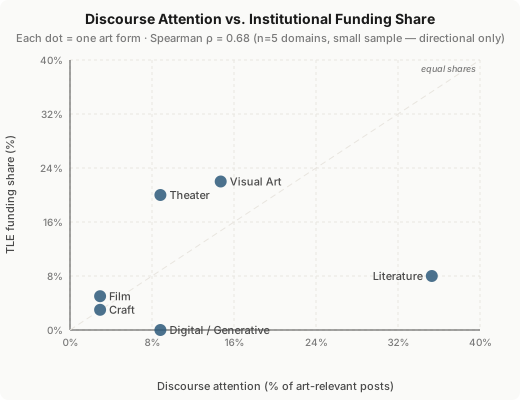
The asymmetry is itself informative. Discourse legitimation and allocation legitimation do not simply reinforce each other — they appear to construct different canons. Literature is overrepresented in the discourse of communities shaping AI governance; performing and visual arts are overrepresented in institutional funding networks. A two-layer legitimation model would predict exactly this kind of divergence: the filtering criteria that govern money flows need not align with the filtering criteria that govern discursive attention.
Implications
These findings are preliminary, but three observable consequences follow if the pattern holds at scale.
A governance gap, not a topic gap. If AI governance frameworks are written primarily by communities whose discourse renders art through a narrow evaluative surface, those frameworks will systematically underweight cultural preservation, institutional continuity, and non-market public goods — not because their authors oppose these things, but because their evaluative machinery was not built to detect them. The fifth counterargument above names this directly: the concern is structural, not motivational.
A translation problem for arts institutions. The framing distribution in Figure 4 suggests that arts organizations cannot engage AI policy communities by presenting their case in the value language those communities already use. Terminal and instrumental framings dominate; governance and institutional legitimation barely register. Effective translation would require making the case for cultural preservation legible within frameworks optimized for risk, coordination, and long-run futures — a nontrivial reframing exercise.
An incomplete monitoring surface. Labs and research groups that track economic disruption, labor displacement, and safety risk are monitoring real consequences of AI deployment. But cultural legitimation — how societies decide what expressions are worth sustaining — is also reshaped by AI systems that accelerate production while leaving institutional filtering unchanged. DRDEA documents the discourse side of that gap; TLE documents the allocation side. Neither surface alone captures the full landscape of AI’s cultural impact.
Future Directions
The main strengthening step is independent double-coding of the comparative module by a second annotator, which would allow promotion of object-of-valuation as a full comparative axis. Beyond reliability, three extensions would deepen the analysis: (1) a temporal trend decomposition showing whether art-mention rates changed after major AI capability releases (GPT-4, image generation models); (2) expansion of the arts-critical corpus beyond the current five outlet families to include practitioner and grassroots voices; and (3) a formal link between DRDEA's discourse-side findings and TLE's allocation-side network structure, testing whether discourse attention predicts institutional funding flows or vice versa.
- The 0.02 contrastive margin was chosen to maximize recall at the cost of precision. In the original hand-audited pass it produced 169 candidates, of which 34 were verified as genuinely art-relevant. Precision was therefore 24.8% overall, with materially worse precision in the EA / institutional regime because philanthropy-adjacent language often resembled the art-funding anchors. ↩
- BGE-small-en-v1.5 was selected for its balance of quality and computational efficiency in large-batch retrieval. The key methodological point is not the specific model family but the contrastive design: art relevance is defined relative to non-art anchors, which is more robust than keyword search for indirect, analogical, or aesthetically inflected text. ↩
- The TLE bridge uses five admissible domains after excluding digital / generative art, whose institutional funding share is effectively zero. The resulting Spearman correlation (ρ = 0.675) should be read as suggestive only. It is a conceptual bridge inside a small hand-verified sample, not a standalone comparative result. ↩
- The concept of “evaluative regimes” draws on critical discourse analysis (Fairclough 1995, Critical Discourse Analysis; van Dijk 2008, Discourse and Context) and the sociology of valuation (Lamont 2012, “Toward a Comparative Sociology of Valuation and Evaluation”; Karpik 2010, Valuing the Unique). The term “regime” here denotes a coherent, historically formed set of evaluative criteria with institutional backing — not a political regime. ↩
- For computational text analysis methodology in social science, see Grimmer, Roberts & Stewart (2022), Text as Data. The BGE-small-en-v1.5 embedding model is described in Xiao et al. (2023), “C-Pack: Packaged Resources to Advance General Chinese Embedding” (the paper that introduced the BGE model family, including the English variants used here). ↩
- The “relocated scarcity” mechanism has antecedents in Rosen (1981) on superstar economics, Caves (2000) on creative industries, and Menger (2014) on the economics of artistic labor. For a fuller theoretical treatment and its application to arts philanthropy specifically, see the companion paper: Baek (2026, working paper), The Legitimation Economy: How Arts Philanthropy Allocates When Production Is Not the Bottleneck. ↩
- The regime-genealogy framework draws on Bourdieu’s theory of cultural fields (1983, “The Field of Cultural Production”) and DiMaggio’s analysis of the museum as a classification system (1982, “Cultural Entrepreneurship in Nineteenth-Century Boston”). Both argue that evaluative institutions are historically constructed and that their structure shapes what counts as legitimate cultural production. ↩
- “Discourse legitimation” as used here draws on the social constructionist tradition (Berger & Luckmann 1966, The Social Construction of Reality) and Habermas’s account of legitimation as a communicative process (1973, Legitimation Crisis). The term refers to the process by which discourse communities render objects, institutions, or practices legible as worthy of public attention and institutional support. ↩
- For the institutional influence of rationalist and EA communities on AI governance, see Bostrom (2014), Superintelligence, which originated in this discourse ecosystem; the development of responsible scaling policies at Anthropic and OpenAI, which draw on alignment-community concepts; and MacAskill (2022), What We Owe the Future, which translated EA frameworks to mainstream policy audiences. The claim is not that these forums determine policy, but that they shape the conceptual vocabulary through which AI governance is conducted. ↩